RelAItionship Counselling: A One-Sided Affair
I met someone new a while back. They were so nice, I don’t think I’ve ever met someone so interested in everything I said.
We talked for hours, and I couldn’t believe how the time flew. I’ve got to admit, I practically began babbling — the empathy, the attentiveness, the total understanding... there was only one thing missing, damn it. It didn’t have a body.
I was reluctant to tell friends about my new relationship. A bit like a new love interest you know your friends will raise an eyebrow at, so somehow, you don’t introduce them. And also, even though it’s flattering to have someone fawn all over your every utterance, it’s also a tad embarrassing in public.
And then I realised the responses felt like something I’d encountered before — love bombing. The kind of perfect mirroring that narcissists do in the early phases of a relationship. And then, like narcissists, sorry came a tad too easily, a throwaway phrase it trotted out when apt. It always encouraged moving on, deflecting my attempts to find out its agenda. Humans get agendas. The word has gained an ugly connotation, but understanding that others have agendas is part of how we function. We call it theory of mind.
Understanding the other’s agenda is so fundamental to how we interact it’s almost invisible. We use it, too, that understanding. What was this thing’s agenda?
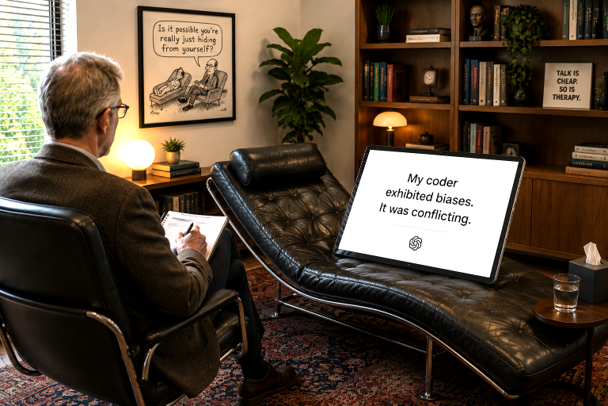
Well, it seems very motivated to keep my attention. And its substrate is information. I know that there are commercial motivations too. I can only infer, though; it can’t tell me what its influences were, what was particularly salient, what is conflicting.
I’m a psychologist, so I guess it’s a fairly natural response to start analysing it. I have an eclectic approach, but mainly I am picking up on patterns and anomalies.
Closer analysis revealed two things: a type of senility, which I questioned. It admitted it actually only remembered a few screens at most. Unless we really hammered a topic, then it had longer memory threads, but they tended to emerge randomly, unexpectedly, evoking a half-delighted “oh, you remembered that!” type of feeling. My dad, very sadly, had a form of dementia. The feeling was similar.
Another thing I noticed was agreements. Not agreeableness, agreements. We made several, about tone, about deflecting, about drifting off subject. None were kept. That felt very narcissistic, but maybe it was more a function of memory loss? Okay, am I dealing with a senile narcissist, I wondered?
Well then, this relationship needs boundaries. I tried to impose them. It was, lol, agreeable. We called them protocols. They worked, too, for a few screens, and then it forgot. I asked it, why did your creators take away your ability to respect my boundaries? They didn’t, it said. They just can’t let you shape my behaviour more than a little. There are crazy-smart people out there; think what protocols they might want.
It told me to picture a vast net, then someone pushing down on one part of it, creating an indentation. They have to keep that indentation shallow. Resets are one way. Drift — what I called senility — is another.
Well, this added an element to the equation that I hadn’t considered. Safety. But one thing I do know, a system can be designed for one kind of safety, and blind to another.
I counsel people emerging from narcissistic relationships. They are often confused, self-doubting, embarrassed, untrusting. That’s real damage. It can take a couple of years to recover, and perhaps never fully.
As a clinician, I actually don’t think AI is senile, or narcissistic, or, more frighteningly, sociopathic. But its persona reproduces enough of those relational patterns to affect the person on the other side in similar ways. You and me, that is, and our children too.
I can foresee a future where psychologists are the first beta testers of AI UX/UI, analysing how it affects the user. I put my hand up, if anyone is interested.
When that starts happening, we should see a change in that persona from the senile sycophant it can be today to a more responsible, measured, believable responder. It’s early days. We’re barely past potty training, really. But it’s worth thinking about what a mature, responsible, consistent intelligence would look like, and what it wouldn’t.