When Civic Memory Fails: An AI System as a Prosthetic for Civic Amnesia
I visited Cambodia a few times in the early 2000s. Twenty years after Pol Pot, property and boundary disputes were still getting people killed. That knowledge has sat in my mind ever since, not as a political abstraction, but as one of those practical horrors that follows a society long after the shooting stops. People imagine war ending when the soldiers leave, or when the regime falls, or when elections return, or when tourists start coming back. But civic damage has a longer tail than that. A village may survive the killing and still be unable to prove where one field ended and the next began.
That is not a small administrative inconvenience. It is the point at which memory becomes power. Under the Khmer Rouge, private property in land was abolished, land records were destroyed, cadastral systems collapsed, and the legal and technical capacity to administer land was almost entirely broken. Later reconstruction had to proceed in a country where the pre-existing civic substrate had not merely been damaged, but deliberately erased. Land administration scholars writing about post-conflict Cambodia describe the loss of land registration records, the destruction of cadastral records, the destruction of parcel structures, mass displacement, and the overwhelming difficulty of rebuilding tenure systems after that kind of collapse.
This is what I mean by civic amnesia. A society does not only remember through stories, songs, rituals, monuments, and old people saying, no, the road used to go that way. It remembers through boring things: land titles, boundary maps, water diagrams, court records, survey notes, identity documents, road plans, school records, utility maps, adoption files, building permits, infrastructure drawings, and the patient cross-checking of who said what, when, under what authority, and with what evidence.
I am not suggesting we preserve everything. There are limits. After all, losing my tax records could be quite helpful. But money records? History suggests those are surprisingly flammable. But when the useful records fail, life does not return to some noble state of oral simplicity. It returns to argument. Then, very often, to force.
If nobody can prove the boundary, the strongest neighbour may become the boundary. If nobody can prove ownership, title becomes influence. If nobody knows where the water pipe runs, repair becomes guesswork. If nobody knows where the mines are, the field becomes a lottery. If the court records are gone, the wound does not close. If the archive burns, drowns, or is rewritten, the future starts again from whoever has the power to narrate it.
Cambodia is the war version of civic amnesia. Malaysia gives us the climate-change version. After major flooding in Malaysia’s east coast states, the National Archives of Malaysia had to help restore damaged government records. The reported restoration work included National Registration Department files, adoption files, student records, public-service books, and Magistrate Court records from the 1980s. Some records were the only copies held by those departments; if restoration failed, they would have been lost for good.
That is a quieter catastrophe than a collapsed bridge, but it is still a catastrophe. Water does not need ideology. It does not need a land-grab strategy, or a militia, or a corrupt official, or a victorious army. It only needs a weak archive in the wrong building, a district office in the wrong place, a storage room below the flood-line, and enough rain to turn proof into pulp.
The grim part is that this category of failure is not mysterious. Records-disaster planning exists. Archives know about it. Governments know about it. Disaster management manuals know about it. Researchers study it. The problem is not that nobody has ever thought of flood, fire, war, mould, corruption, theft, and neglect as risks to civic records. The problem is that vital records still too often sit inside systems that behave as if disaster will be polite.
It will not.
And the cloud, useful as it is, does not solve this by magic. “Back it up to the cloud” is not a wrong answer, but it is an incomplete one. The cloud depends on electricity, telecommunications, data centres, cables, authentication systems, institutional continuity, and political access. In a stable society, those conditions are almost invisible. In a war zone, flood zone, occupied territory, cyberattack, grid failure, or administrative collapse, they become highly visible very quickly.
Civic memory therefore needs more than storage. It needs resilience. This is where a dedicated AI system may have one of its most useful roles. Not as ruler, judge, oracle, saviour, or replacement government. As a prosthetic for civic amnesia.
A prosthetic does not replace the body. It supports a damaged function. In the same way, a properly constrained AI system could support damaged civic memory by helping communities preserve, compare, reconstruct, and interpret records that would otherwise be lost, fragmented, contested, or inaccessible. Its core role would be archival, but not passive.
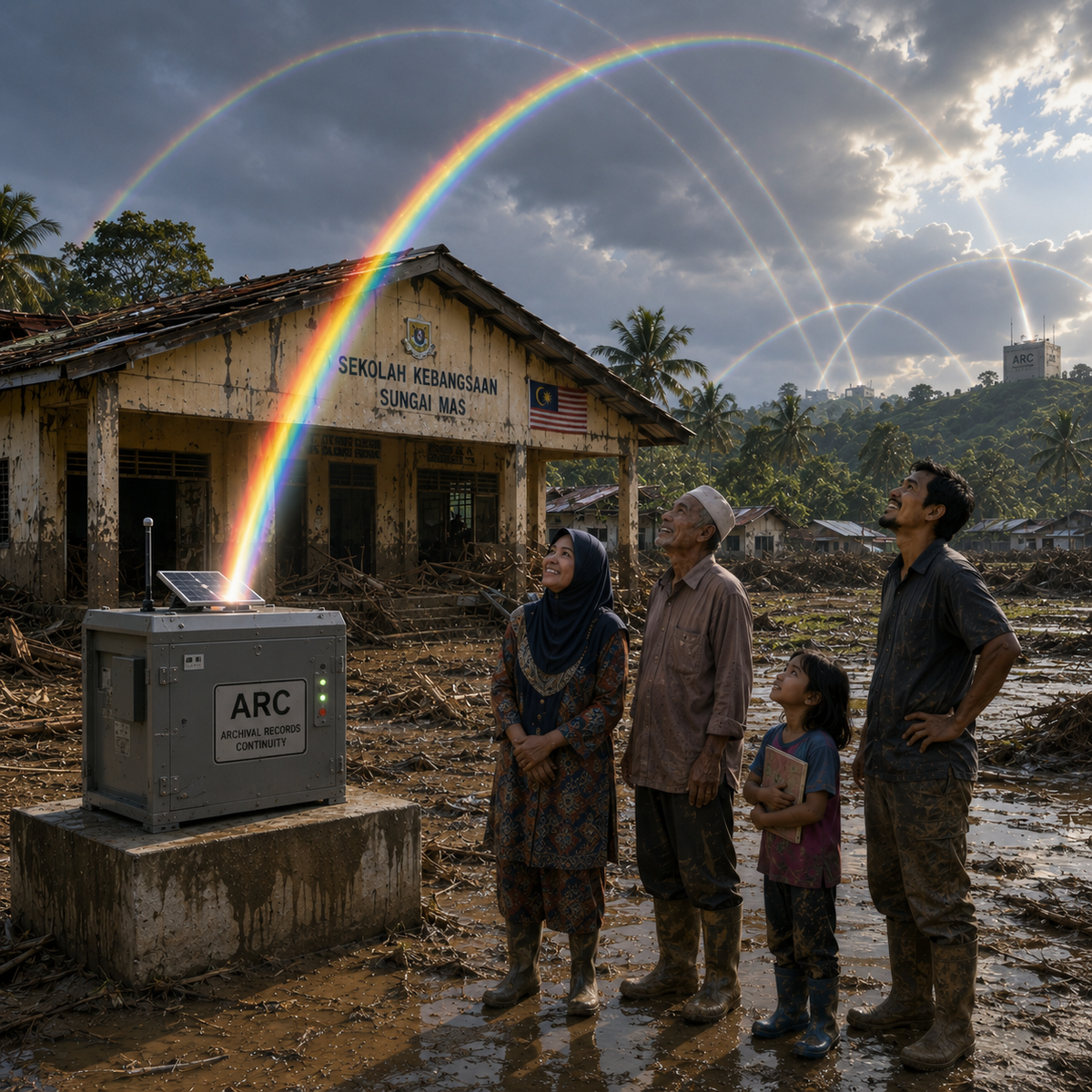
An Archival Records Continuity system — ARC for short, because some icons never fade — could hold civic memory in a hardened, low-power, tamper-resistant form. Not everything. Not a fantasy archive of the entire internet. The core things: land boundaries, titles, water systems, roads, drainage, electricity, public buildings, hazard maps, mine-risk areas, court records, identity registries, local agreements, and repair knowledge.
ARC would not sit alone. Each local unit would hold its own community’s civic records, but also encrypted copies of the civic records of neighbouring communities. Across a region, the systems would form a distributed civic memory mesh. If one town hall floods, burns, is looted, or loses power, its records are not gone. They still exist in hardened local systems nearby. If the cloud is available, the mesh can sync to it. If the cloud goes dark, the mesh remains.
The point is not local-only storage, or cloud-only storage. It is layered redundancy: local, regional, and cloud, with each layer able to compensate when another fails. The records physically reside in the community and across its regional civic mesh, because the memory must remain close enough to survive institutional failure, but distributed enough to survive local destruction.
But the important part is not only the record. It is the provenance. A record without provenance is not memory. It is only a claim waiting for someone stronger to contradict it.
Who recorded this boundary? When? Under what authority? Who witnessed it? Was it surveyed? Was it disputed? Was it changed later? Was there an appeal? Was the record copied from another record? Was the chain of custody intact? Was the update made during war, displacement, occupation, emergency rule, or under obvious coercive conditions?
That is where a dedicated AI system could become more than a filing cabinet. It could act as a metadata engine: not deciding truth, but marking the strength, source, history, and vulnerability of claims. It could distinguish between an original record, a scanned copy, an oral testimony, a satellite-derived reconstruction, a neighbour’s claim, a court ruling, a disputed title, and a post-disaster administrative patch. It could show uncertainty instead of hiding it. It could flag contradictions instead of smoothing them into false confidence.
In a damaged society, that matters. People do not need an artificial oracle handing down land rights from the machine. They need a way to stop the strongest actor from pretending there was never any record at all. The reconstructive function may be just as important. When civic memory is partially destroyed, a dedicated AI system could compare surviving fragments: old maps, satellite imagery, local photographs, cadastral surveys, utility diagrams, oral testimony, adjacent titles, road alignments, drainage patterns, building footprints, school records, court references, and administrative logs. Not to produce certainty where certainty is gone, but to make the remaining evidence legible.
That is the prosthetic function. It extends the damaged capacity to remember.
The governance problem is not trivial. A local archive that can be opened by whoever controls the building is vulnerable. A corrupt official, occupying force, militia, or desperate local powerbroker could try to seize the box, rewrite the boundary, delete the inconvenient record, or force someone with access to cooperate. The keys to civic memory cannot all be in the room.
One possible model is a dual-key system. The records physically reside in the community and in the regional mesh, because the community is where the memory belongs. But administrative access, amendment, or high-risk release may require an external authentication signal from a recognised neutral body operating under disaster or post-conflict protocols. That might be the UN in some settings. It might be the Red Cross or Red Crescent, a regional body, a treaty-backed archival authority, or a verified quorum process when no external body can safely operate.
The point is not to make an international organisation the owner of local truth. The point is to create friction against coercion. The archive says: the record exists here, but no single frightened librarian, mayor, soldier, contractor, developer, or district official can quietly rewrite it. That is a modest ambition, but a serious one.
It also brings this back to substrate. I have been using that word in relation to ecology, biodiversity, land, water, and the living systems that make human life possible. But civic memory is also substrate. It is the human layer of substrate: the record of how a society is joined together, where obligations lie, what can be repaired, what is dangerous, who has standing, what was promised, and what cannot honestly be erased.
When civic memory collapses, the human substrate collapses with it. This does not mean every piece of bureaucracy is sacred. Some records are cruel. Some are false. Some are instruments of theft, exclusion, and control. But that is why provenance matters. Civic memory is not the worship of paperwork. It is the preservation of enough traceable reality that lies, force, flood, fire, and opportunism do not get to start from a blank page.
There is a kind of violence in making people prove again and again what was already known. The widow whose land boundary vanished with the district office. The farmer whose field now sits between old memory and new money. The family whose adoption record was a wet bundle in a government storeroom. The village that cannot repair its water line because the map disappeared. The people who survived the war but not the paperwork after the war.
These are not edge cases. They are what happens when record systems are designed for normal weather, normal politics, normal electricity, normal offices, normal goodwill, and normal days. But many people do not live in normal days.
A dedicated AI system in this context would have one job: preserve and help reconstruct civic memory when ordinary systems fail. Not decide ownership. Not override law. Not govern the community. Preserve records, expose provenance, compare fragments, flag uncertainty, and make civic reality harder to erase.
Make it stubbornly archival. Make it preserve chain of custody. Make it expose uncertainty. Make it remember what power would prefer forgotten. Make it help reconstruct what flood, war, fire, corruption, and neglect have broken.
Not as master memory. As prosthetic memory.
A society that loses its records does not only lose administration. It loses part of its capacity to defend reality. And when reality is no longer defensible, the future belongs to whoever can afford the bulldozer, the gun, the lawyer, the server, or the lie.
An Archival Records Continuity system would not prevent war. It would not stop floods. It would not abolish corruption, greed, stupidity, opportunism, bureaucracy, or whatever small demon lives in the office printer. But it might help stop the second catastrophe.
It might help a community remember enough to rebuild without beginning again from amnesia. And sometimes, after the water drops or the soldiers leave, that may be the difference between recovery and another generation of quiet, bureaucratic violence.