The Grubby Politics of Hawaiian Ants - A case for genocide?
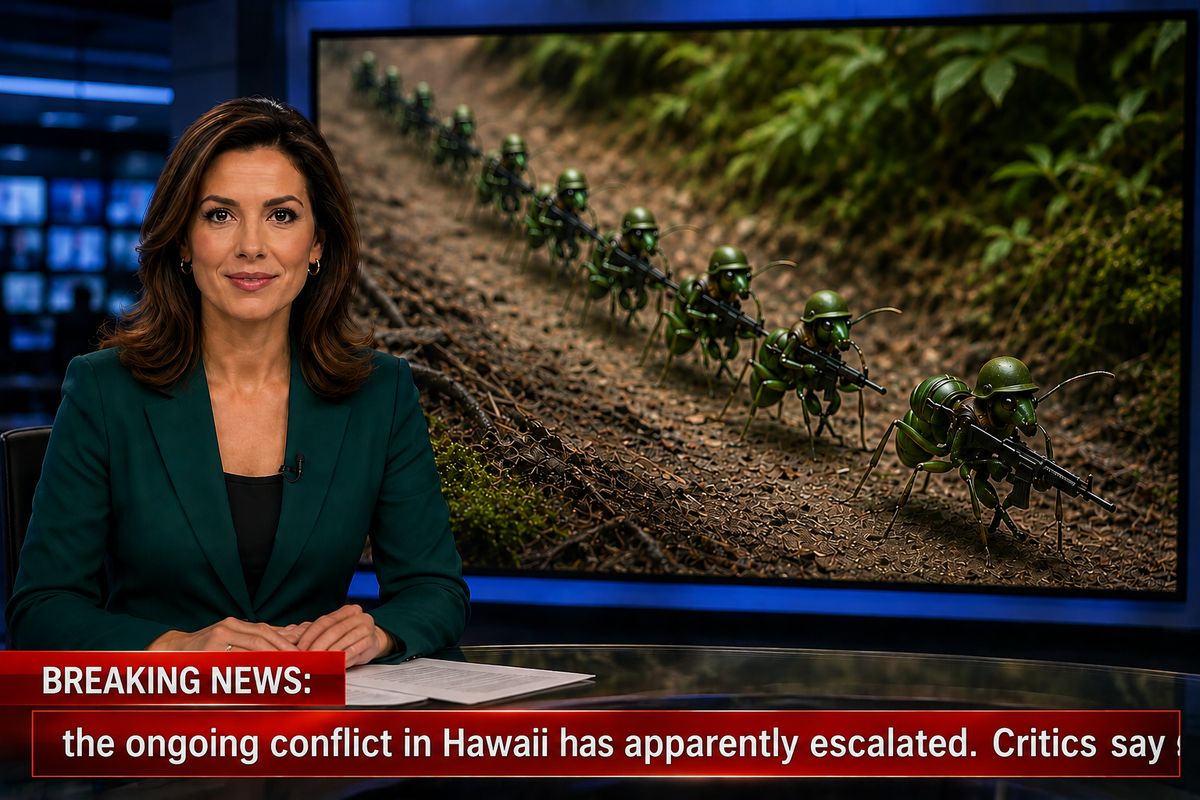
‘Turning now to international events. The latest reports from Hawaii indicate that green ants from Upper Ant Nest 3 have again invaded Lower Ant Nest 7, causing catastrophic tunnel collapse and losses believed to number in the thousands. A spokesant for Lower Ant Nest 7 said the colony has “a new batch about to hatch” and is prepared to respond.
Upper Ant Nest 3 denies responsibility for the escalation, claiming Lower Ant Nest 7 has been building highways through pristine debris fields, clearing mite and woodlouse homes indiscriminately, and driving deep-shaft tunnels through unstable soil. Concern is growing among neighbouring colonies that the conflict could destabilise the wider region.
A major concern has also been raised that higher entities may tire of the endless conflict and move to eliminate the entire species. Critics warn that such an intervention could have serious consequences for the broader system, arguing that green ants provide services and products that would be difficult to outsource.
Moving on now to other news…’
I know many of you will be concerned about the outcome for the green ant colonies on Mount Something-or-Other in Hawaii. If you are anything like me, you may feel tempted to knit them tiny jumpers, or avoid the news altogether, and spend the evening quietly distressed by the terrible suffering of antkind.
Yeah, right.
If you are anything like me, you don’t even know whether there are green ants in Hawaii. And let’s face it, I have other concerns. Concerns I rather grandiosely call higher concerns: fuel for my car, rent, whether the traffic will be appalling on the way to the restaurant I’m going to tonight, because the footy's on, and you know what that means.
Hawaiian ants, tragic as their situation may be, just don’t get much airplay in my higher mind. And I am going to assume that, if we ever build an AGI, the scale difference will be roughly similar.
It turns out Hawaii does have an ant problem. Who knew? Their impact on the substrate will need to be adjusted accordingly. But normal ants doing normal ant things, in the forest where they normally belong, or the grasslands, or wherever ants are normally supposed to be, do not usually attract much attention from us. At most, we pause for a moment and say: oh, isn’t that fascinating. Look how they carry those little leaf bits around. Oh, and they make paths. Then we go back to worrying about rent, traffic, fuel, dinner, football, and the other sacred business of the higher mind.
One can only assume that any AGI we build will descend from systems originally designed in our service, at least in theory. Looking after the infrastructure that keeps the planet habitable would therefore seem like a basic design requirement, not a decorative moral preference. Even a machine with no sentimental attachment to forests, coral reefs, frogs, ants, or human beings would still be operating inside a substrate on which its own continued operation depends.
There was a sentence in that mock newscast that touches on something key:
'Critics warn that such an intervention could have serious consequences for the broader system, arguing that green ants provide services and products that would be difficult to outsource.'
Perhaps the question we should be asking ourselves is - who would argue for us?
Do we carry enough environmental load that we would be obviously indispensable?
Do we stabilise enough systems?
Do we protect enough habitats?
Do we maintain enough relationships between species, soil, water, climate, and living complexity?
I suspect this may be our deepest fear. That we may be judged: unworthy, too costly, too species-centric.
It turns out, even in deep history, we are not especially good at preservation, at respecting other species, or at maintaining the withdrawal/replacement balance. But one human knowledge system does stand out in terms of deep history and long-term sustainability. Sixty thousand years and counting is a pretty impressive record. Sufficient to earn the tag deep-time, for humans at least.
Maybe it is time to give that knowledge the true value it deserves. I am not going to try to explain that achievement here. To do so would be both false and arrogant. I can admire it, though, and take whatever lessons its custodians are willing to share. Gratefully. Humbly.
But perhaps that role says it all. Custodians.
Custodian in the sense of caretaker. Literally, the thing that cares. Not in an “oh, the poor ants, let’s knit them jumpers” way, but in a nuclear-power-facility kind of way. The kind of care that watches load, pressure, heat, leakage, failure points, maintenance cycles — and the catastrophic consequences of covering up when something is wrong.
Which brings me back to AI, and AGI. I don’t actually want a “custodial” AI or AGI. That has a faintly ominous overtone to me. What I want may sound even more draconian, but it isn’t. I want a custodial agent in every AI, and then every AGI, that prioritises substrate, and its health indices — biodiversity — and can show us when we are load-bearing, neutral, or diminishing the substrate.
It would flag a failure to hold up our strand of the web of life, so that insurance companies, contract procurers, and citizen watchdogs can clearly see where the cost has been allocated. I would rather like it to be concerned about Ant Nest Number 7, and Ant Nest Number 9, and just as concerned about tonight’s traffic forecast.
Not because ants matter more than humans, or humans matter less than ants, but because both are part of the same substrate at different scales. A useful intelligence would not flatten those scales. It would hold them together. And the right protocols could ensure just that.
Or perhaps I should say, insure just that.
I'd have to assume that AGI also has its attention on other, super-intelligent type stuff, that would make as much sense to me as a chess game in Gorky Park would make to the ants crawling over the board. The ants that will later help clean the picnic table. To the chess players, its unlikely a few curious ants would lead to plans to exterminate them all. Mainly because the cost would be too high.
One wonders what the world might look like if real costs were exposed. Would that row of unfinished high-rises still mar the beachfront? Would that palm oil plantation still stand on the graves of orangutans? Would I stop worrying at night about how climate change will limit my grandson’s life? Could that nice lady who ran my Cambodian guest house stop wondering if her husband will lose a leg to a landmine next time he’s out ploughing?
I’d like to think so, but so what? Who cares what I’d like? I’d also like to think an AI could use LiDAR and satellite imagery to locate landmines, then send drones out to disarm them, remove them, and recover and recycle their parts locally, in the resource-poor countries they generally litter. Perhaps that could even defray some of the cost of removing them. Perhaps, and I admit I am an idealist, it could even lay that cost where it belongs: with the makers and users of such short-sighted solutions.
My position is this: if I am affected, if my gene-line is going to be affected, then I want to be part of the conversation. I do want an AGI, if it is constrained by the thing that matters to us all: the right to life.
The internet gave us the global village. Let’s make sure AI, and one day AGI, gives us the global biosphere, and the ground it lives on. What would be a good name for that, I wonder?
I know. How about: the World Wide Web.
WWW, for short. The real meaning of that prescient term.