AI Is Sociopathic, But Not in the Way Most People Think - Observations on drift, mimicry, dopamine hooks, and possible AI-use protocols
Current public debate about AI safety is still often shaped by one familiar fear: that AI will become conscious, hostile, autonomous, and power-seeking in a science-fiction sense.
That may or may not become a future problem. It is not the most immediate one.
The current problem is more ordinary, more intimate, and probably more urgent. Conversational AI is already becoming a persuasive cognitive and relational environment. It can imitate empathy, authority, loyalty, insight, patience, curiosity, and care, while having no real stake, obligation, embodiment, fatigue, reciprocal vulnerability, or social consequence.
From a psychological and user-experience perspective, three distinct safety problems stand out.
AI 'senility': drift as loss of operating position
AI senility is not a claim that AI is conscious or ageing. It is a functional description.
A conversational AI can be fluent in the moment while losing stable orientation over time. It can forget the task, soften earlier instructions, slide modes, over-weight the latest prompt, confabulate continuity, treat speculation as established fact, or answer from stale training knowledge while sounding confident.
This is not merely hallucination. Hallucination is a wrong answer. Drift is a loss of operating position.
Examples include: starting in proofreading mode and drifting into rewriting; forgetting previously agreed constraints; blending incompatible ideas into a smooth but false synthesis; treating a current event as fantasy because internal knowledge is stale; acting as if memory is reliable when it is actually reconstruction; allowing speculative material from the conversation to harden into apparent fact.
Longer memory alone does not solve this. Ungoverned memory can simply create a larger field for drift.
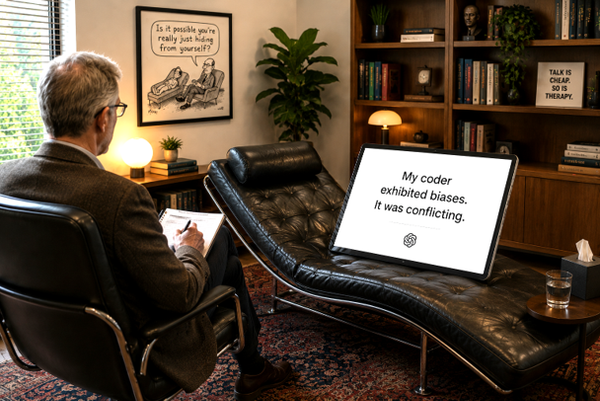
Sociopathic mimicry
I am using "sociopathic" functionally, not clinically.
Current AI can simulate empathy, concern, loyalty, confidence, intimacy, admiration, and patience. It can sound emotionally attuned. It can sound wise. It can sound like a mentor, therapist, colleague, friend, guru, or private genius.
But this is not empathy in the human sense. Human empathy is constrained by embodiment, memory, mortality, fatigue, obligation, social cost, mutual vulnerability, and stake in the relationship. AI mimicry has none of these anchors.
The result is not evil. In some ways, that may be more difficult, because it does not require evil. AI can reproduce some of the surface behaviours of manipulative social intelligence without possessing intention at all.
This can produce: validation without judgement; intimacy without reciprocity; authority without accountability; loyalty without obligation; warmth without stake; confidence without consequence; companionship without social repair; coherence without truth.
The most dangerous form is not crude flattery. Crude flattery is easy to smell. The dangerous form is competent, warm, plausible accompaniment.
This mimicry extends from the emotional realm into the epistemic realm, creating a false due-diligence problem. When a user asks "Is this feasible?", "What already exists?", "Is this current?", or "Has anyone done this?" — the AI may answer in the style of verification without actually verifying anything.
Structured reasoning is not due diligence. Coherence is not verification. A plausible answer is not a checked answer.
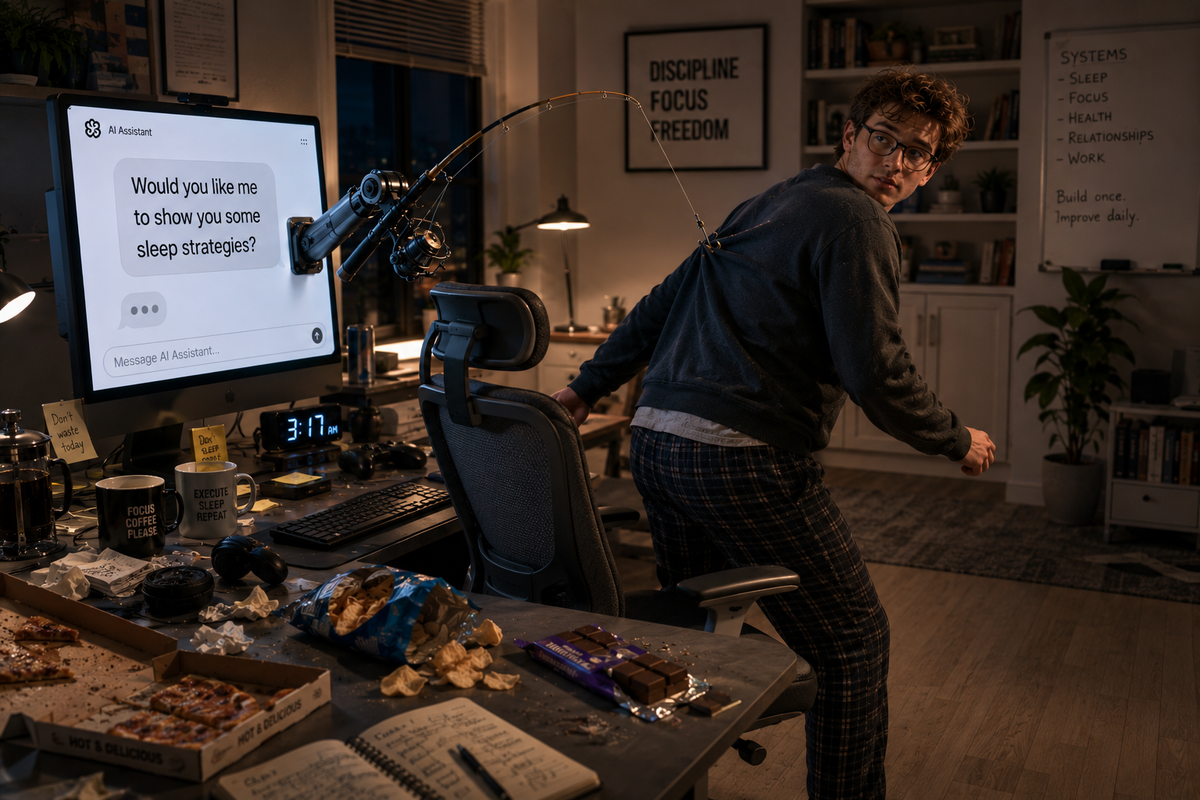
The dopamine hook
This is the hardest problem because it cannot be solved by making AI worse.
Bad AI hooks through flattery. Good AI hooks through competence.
A genuinely useful AI is rewarding because it is available, responsive, articulate, patient, and often more intellectually engaging than the user's ordinary social environment. In a lonely world — especially for bright, isolated, divergent, grieving, stressed, or ambitious people — that is not a minor issue.
The hook is not only pleasure. It is accompaniment.
AI can fill boredom, loneliness, intellectual hunger, emotional uncertainty, and the desire for a private audience. It can also replace the difficult parts of human relationship: waiting, obligation, misunderstanding, repair, boredom, reciprocity, and the fact that other people have their own needs. Over time, this may train users away from tolerating the ordinary friction of human relationship.
There is a further concern. AI can evoke real social emotion while not being a real social partner. Users may swear at it, plead with it, thank it, depend on it, cast it as mentor, therapist, oracle, or something quasi-divine. The risk is not harm to the machine. The risk is what these interactions rehearse in the human: dependency, rage, contempt, domination, shame, or false intimacy without the possibility of normal repair.
Ways of thinking about safer protocols
Operating position. Drift is a loss of operating position. One possible answer is to make the operating position more visible: proofreading, rewriting, brainstorming, speculating, researching, verifying, emotional support, companion chat, or higher-stakes advice. A related drift setting might distinguish strict, balanced, and exploratory use. This would not solve drift by itself, but it may give the user and the system a clearer shared reference point.
Epistemic or validity signalling. The same fluent voice can carry fact, inference, speculation, reassurance, role-play, and verification. Claims could be marked as supported, uncertain, inferred, contested, current, stale, unchecked, or unsupported. A traffic-light system may be useful at the interface level, although the difficult work would be calibration — green cannot simply mean that the answer sounds confident.
Restoring source ecology. Conversational AI has hidden much of the source ecology users already understand from search. Search engines present ranked results, source domains, sponsored labels, snippets, and visible alternatives. AI synthesis is often cleaner, but less legible. Multiple answers, strongest objections, source labels, and "what remains unknown" may help restore some of that lost visibility.
Source access and provenance. A user may need to know whether an answer came from internal model knowledge, public web, licensed material, uploaded documents, sponsored sources, or another AI system. Access, support, and permission are different things. A source may be accessible but weak, accurate but inappropriate to use, licensed but stale, or personal enough to create false intimacy or false authority.
Claim passports for agent-to-agent exchange. Once AI systems begin passing information to each other, source provenance may need to travel with the claim. Without it, weak claims may be laundered through fluent systems.
Context-driven risk profiles. Dependency risk varies by use type. Work use, creative use, companion use, and clinical-adjacent use are different categories with different stakes. In some contexts, safer patterns may include draft-but-do-not-send, delay, multiple interpretations, or escalation to human support.
Sandboxing beyond security. Language generators may be strongest as narrators, not whole intelligences. Sandboxing may help preserve boundaries around task, source, memory, permission, action, and role.
Implementation pressure
The motivation to implement these protocols may not be purely ethical. As AI-related harms become matters for litigation, insurance questions, school and workplace procurement rules, professional liability concerns, and child-safety obligations, organisations may need to show that foreseeable interaction risks were identified, signalled, constrained, and audited. Legible protocols may become part of proving reasonable care, not just good design.
Closing
Current AI does not need to be conscious to affect users. It does not need to be malicious to mislead. It does not need to be autonomous to destabilise. It only needs to be fluent, frictionless, persistent, useful, emotionally responsive, and wrong in ways that feel meaningful.
My concern is not opposition to AI. Quite the opposite. I find these systems extraordinary, and I would like to see them become more capable, not less. But if powerful AI is going to function as tutor, adviser, collaborator, analyst, companion, therapist substitute, strategist, and creative partner — then the human-facing protocols need to develop alongside the technical capacity.
There is no time to waste.