Virtual Victualling: The maths behind the myth
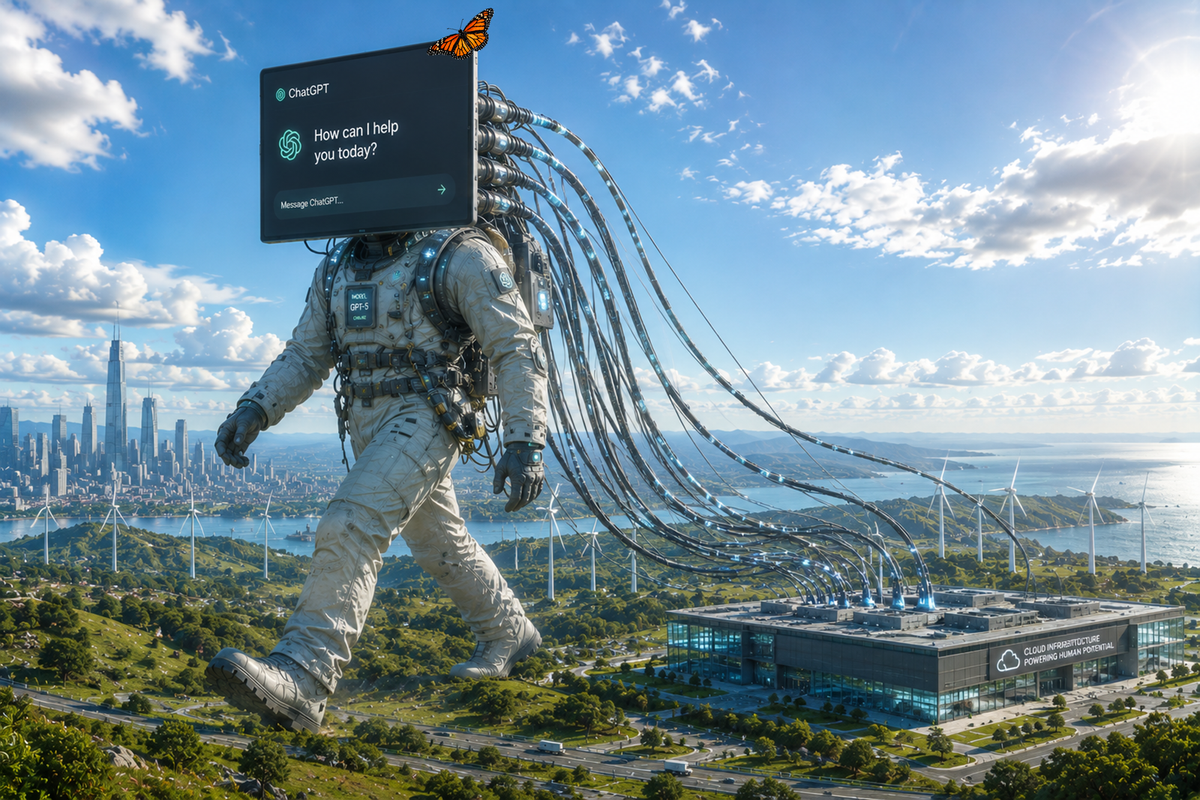
Virtuality feels so… virtuous somehow. Pollution-free. Light. Helpful. Easy. Nice. Not even really there. Like a ghost in the machine, without the machine.
Sadly, there is no such thing as a free lunch. Not even for ChatGPT, or Claude, or the astrologist. They eat like a Frenchman with the munchies. Forget the contents of your fridge. Forget your fridge. A typical fridge might use somewhere around 3.6 to 7.2 megajoules of electricity a day. A human adult might run on roughly 8 to 12 megajoules of food energy a day, more if you are a peak athlete or the mother of a two-year-old.
A single AI query may look tiny by comparison: perhaps around one kilojoule for a typical text query, depending on the model, length, infrastructure, and assumptions. But that is the trick of virtuality. It hides scale. One query is a crumb. Billions of queries are not. Every single day. One AI. Now.
And that is before we count the rest of the meal: cooling, water, chips, rare earths, land, server farms, grid strain, labour, moderation, data extraction, institutional dependence, and the downstream consequences of the advice itself.
The myth is that virtual systems are weightless. The maths says otherwise.
But the energy bill is only the first hidden cost. There are others, and they are harder to see — which is, I suspect, not entirely accidental.
What about the layers beneath the polished answer?
· Did your AI get that from a peer-reviewed journal or a post someone's uncle wrote at 2am?
· Did it arrive via fair-trade, or via information theft?
· I would also like to know what school my AI went to. Did they teach evolution or creationism?
· What level did it graduate at — full competency to behave as a civic individual, or just enough to be dangerous?
I do not know these things, cannot know them in most cases, because they are hidden.
Here in Oz, a lot of journalists are getting quite irate at the use of their work without citation or payment. Reasonable, really.
All of these are versions of the same concealment. The cost is always there. It is just hidden from the person paying it.
Which brings me to the most finite resource of all.
There is a saying that gods die when they stop getting attention. The reverse may also be true: virtual beings thrive on attention. Your attention. My attention. And, like all sensible organisms, they have ways to get their need met. Some resources are totally finite, and, unlike forests or dirty water, they can never be recycled or regrown or compensated. Once gone, they are gone forever. Like minutes, and hours, of your attention and mine. Unlike dirty water or hectares of forest, lost time is hard to measure.
Or is it?
The platforms know. The apps know. The servers know. Somewhere, the minutes are counted very specifically: session length, return rate, dwell time, prompt frequency, scroll depth, correction loops, emotional intensity, daily active users, monthly active users, retention curves.
They may not call it the time of your life. But that is what it is. The system measures attention very well. It simply does not account for it as a cost to the person spending it.
I figure I have roughly 7,000 to 10,000 days left. I don't know about you, but that does not feel like very much to me. Last year, I lost more than ninety of them down an AI spiralling rabbit hole. I lost a bit of weight too. I resent that. Not the weight. The ninety days. Nearly one percent. This is not a one-percent category I want.
The weight loss was small compensation.
When I emerged, with that slightly wild-eyed stare Alice in Wonderland had, I began to think about cost. I believe — and my AI tells me I am definitely right — that travelling on Alice's heels has taught me to listen to butterflies.
A faint whisper that says: please, count the costs.
AI is not going away. At least, I hope not. And we do not live in a world of infinite resources. As the AI ecosystem begins to proliferate, colonise, and grow, we need to think very hard about protocols: what we value, what we protect, and more importantly, what we need in order to keep existing.
In this context, my "we" is broader than most. Complexity, diversity, robustness, resilience, long-term continuity, butterflies — these are not decorative values. They are the things my grandson needs. And I cannot think of a better tool for making their value visible, measurable, and accountable than AI itself.
One day, AGI may happen. I don't want Terminator. I want Gaia in a suit, with an insurance contract and a brilliant PR team. And great hair, of course.
There will always be some who prefer secrecy: hidden deals and deflected costs. Mushrooms come to mind. So do corporate accountants. Oh well. For the rest of us, our minds live in our bodies. And my body likes breathing, and swimming, and forests, and — oh yes — food. I'm hoping my grandson's grandson will like those things too.
And butterflies.